
Dark Energy Chronicles 1: Death Star Balcony
Ian Condry
June 15, 2012
In late May, early June, I spent a little over a week in Japan, catching up with some old friends, attending a conference, and experiencing Japan anew. I visited some haunts in the Takadanobaba section of Tokyo, where my favorite small-scale nomiya Mosquito and a great old-school tsukemen ramen shop called Benten are still going strong. Part of the time, I stayed in Shibuya, not far from the “scramble.” Looking out the window of my hotel, I was struck by the cityscape. I imagine this is what it would look like if I were a plebeian worker on the Death Star, looking out from my balcony. I can almost see Luke’s X-wing fighter zipping between those two buildings, and me wondering what’s going on.
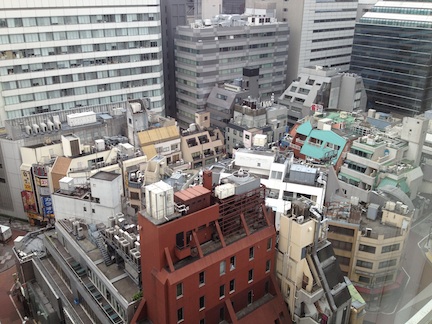
Shibuya, Tokyo, June 2012
Wait a minute, you might say, a plebeian worker with a balcony view from the Death Star? Wouldn’t a window view be prime real estate? Not necessarily. The Death Star would have to travel by suns on its mission of planetary destruction. You wouldn’t want to live on the edge, with a balcony view, if you’re worried about radiation.
This was my first visit back to Japan after the daishinsai (earthquake disaster on 3.11.11). Everyone has their story from that day, some more harrowing than others, though all with a tinge of trauma. At the same time, there is understandable resistance among some people against defining everything in terms of “post-disaster Japan.” It’s complicated. Interesting research is coming out about the disaster and what it means for Japan (see, for example, JapanFocus.org). In Tokyo and the Kansai region (the two places I visited), I found people largely saying life must go on—not everything was defined in terms of disaster. And yet, the specter of radiation had become part of some people’s lives too (maybe everyone’s). “I don’t eat fish anymore.” “My friend may move south, to be far away from the nuclear disaster site.” There was a lot of concern about the restart of a reactor not far from Osaka. The reduced price train and hotel packages to Fukushima had a queasy effect on me. Another friend however noted that it was important not to forget the people living there, that it is worth a trip to hear their perspective on things. That’s something I’d like to do.
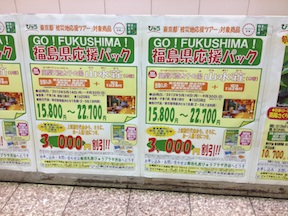
Train discount advertisement, Shibuya Station, June 2012
In the coming weeks, I would like to share some other news from the trip: the Manga Worlds conference in Kobe in Kyoto, a visit to Studio Chizu which is preparing for the July release of the anime film Ôkami kodomo ame to yuki (Wolfkids Ame and Yuki), a look at Utamaru’s new straight-to-DVD soon-to-be cult classic Tamafle: The Movie, as well as some news and views from the music world.
I think of this writing project as the Dark Energy Chronicles. I use the term “dark energy” in my forthcoming book about anime to describe the social energy between people that comes from being together—working, playing, interacting. I think of dark energy as a kind of unseen force that expands cultural universes (a metaphor from the way the term is used in cosmology). From my perspective, dark energy is meant to challenge common individualist assumptions within some social theory (economics, political science) and to encourage instead a sensibility for the intersubjective vibe between people, a kind of connective tissue that enables collaborative creativity and collective action.
Stay tuned also for a mix of some recent (and not-so-recent) Japanese hip-hop.